
A Midsummer Night's Bonfire...
And a peculiarly Cornish Festival

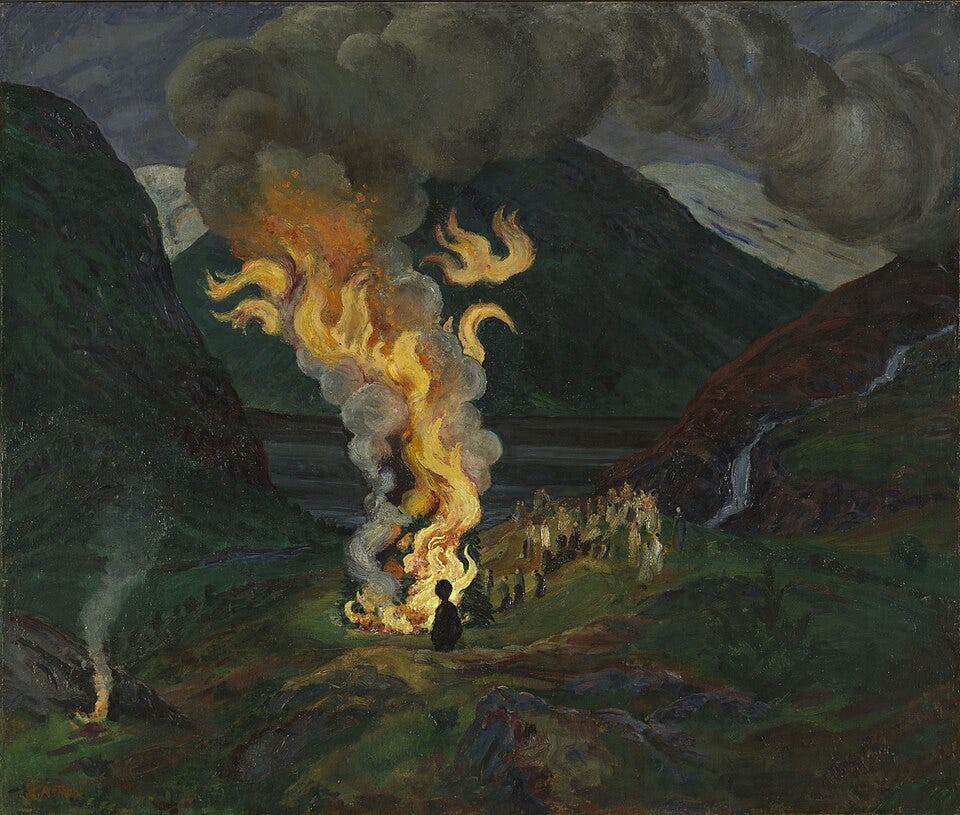
‘Summer Night’ by Nikolai Astrup (1880-1928)
‘When midsummer comes, with bavens and bromes they do bonefires make,
and swiftly then, the young men runne leapinge over the same.
The women and maydens together they do couple their handes
With bagpipes sounde, they daunce a rounde;
no malice among them standes’
Anon 15c Ballad.
This year the Aestival Solstice is on the 21st June at 09.24 am but for reasons I've never really understood Midsummer Day is the 24th, which is the Feast of St John the Baptist. St John’s Day holds a similar position in the summer months to Christmas Day in the winter. It’s a day to celebrate the fullness of the year and to mark the tuning point towards harvest and shorter days. That feels a bit depressing this year as summer has barely got going.
The custom of making bonfires at midsummer is very ancient indeed. In the 4th century, St Vincent described the rolling of flaming wheels down the hills of South Western France, and in the nineteenth century British folklorists found lots of examples of similar midsummer rites. This is a tradition which stretches way back into our pagan past.
The written records of midsummer fires in Britain go back to the 13th century and in the 14th century the Prior of Lilleshall in Shropshire wrote ‘In the worship of St John men waken at even and maken three manner of fires; one is clean bones and no wood, and is called a bonfire, one is of clean wood and no bones and is called a wakefire...the third is made of bones and wood and is called St John’s Fire.’ (John Mirk, Liber Festivalis) *
So that’s what bonfire means - ‘bone fire’ - well I never.
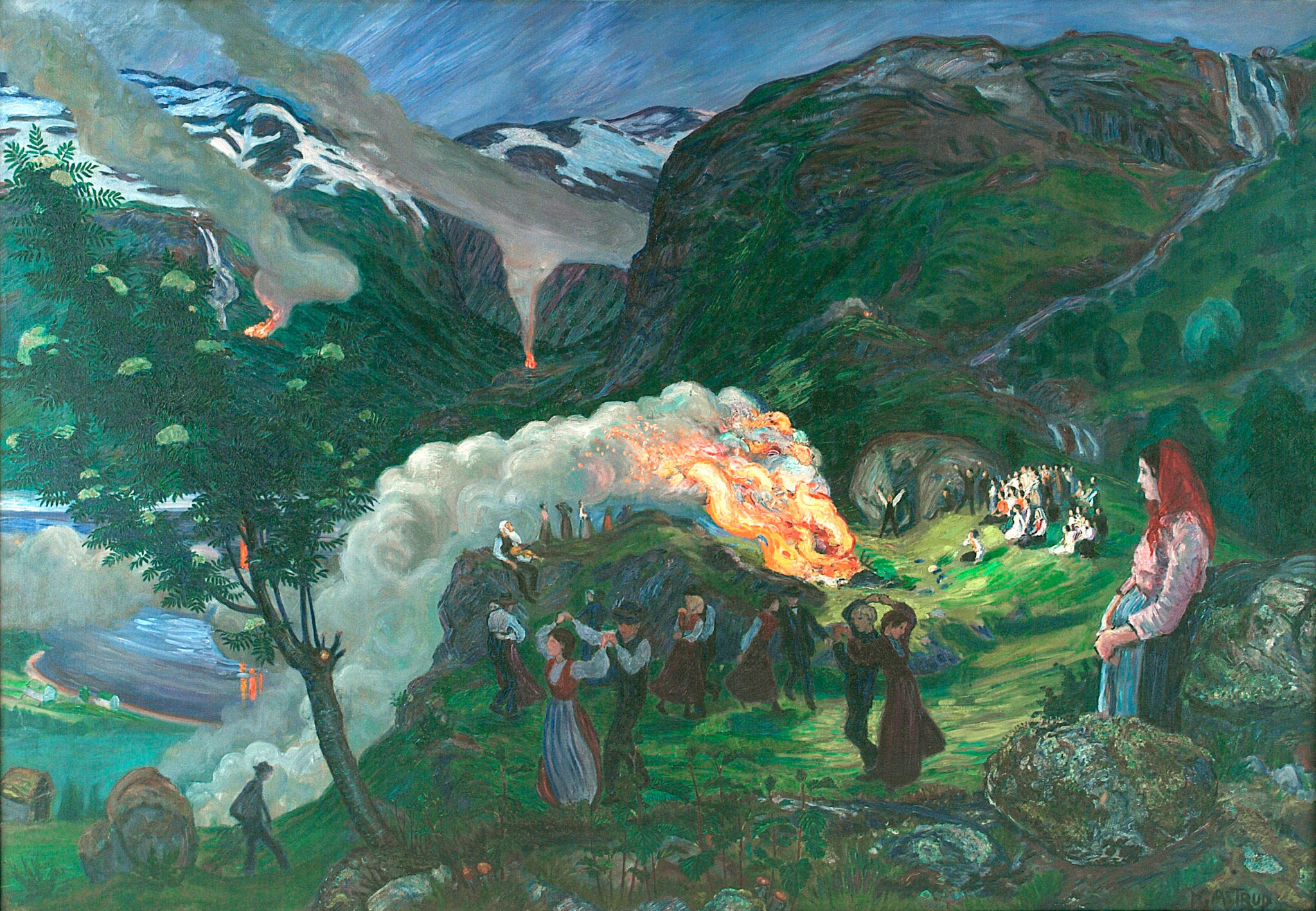
Another midsummer fire painting by Nikolai Astrup this one called ‘Prize Bonfire’ in Bergen Art Museum.
St John’s Eve was also auspicious for the collection of herbs and the making of potions and simples. Churches were decorated with birch branches and fennel. Plays, processions and pageants were common. Midsummer Night was also a topsy-turvey time. Normal rules didn’t apply. Queens might fall in love with weavers disguised as asses, and fairies were up to mischief everywhere:
“Over hill, over dale,
Thorough bush, thorough brier,
Over park, over pale,
Thorough flood, thorough fire,
I do wander everywhere...”
Puck in Midsummer Night’s Dream Act 2 Scene 1
Because the midsummer fires smacked of both Catholic religious fervour and pagan rites they fell foul of the Reformation and of the Puritans. However certain places held onto their old ways and their midsummer fires longer than most. One of these was the most western tip of the British mainland - the Penwith peninsula. Penzance (the name means Holy Headland) was still holding its midsummer revels well into the 1800s. There is a strong link between Penzance and St John through the Knights Hospitallers (properly known as the Order of Knights of the Hospital of Saint John of Jerusalem) who owned Penzance’s mother parish at Madron. I wonder if this contributed to keeping the tradition going?
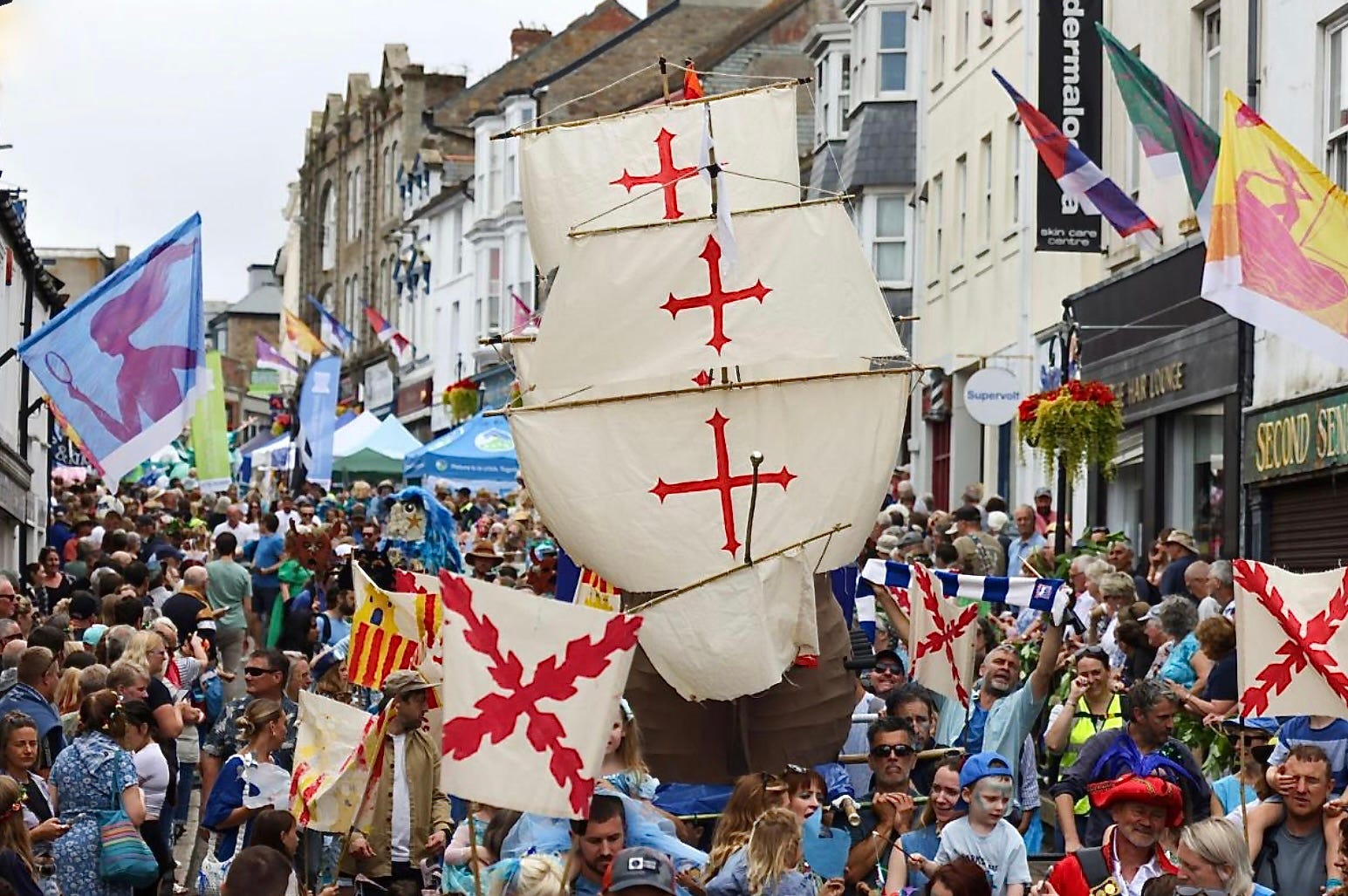
Mazey Day 2025 - photo from The Falmouth Packet.
For those of you who don’t know it, the town of Penzance sits on a stumpy headland poking out in to Mount’s Bay. This means the streets slope in three directions, down the headland’s spine i.e. south towards the sea, then east and west down the sides. The St John’s Eve tradition was to set fire to what you had most of - and here that meant old fish barrels, filled with tar and set rolling like Catherine wheels through the streets. In addition, torches made of canvas soaked in tar and wrapped round poles were paraded around the town. On the Penwith moors, bonfires were lit on carns and hill tops and circle dances took place round the embers. The feast of ‘Golowan’ as it was known, foundered in the late nineteenth century. Two things mitigated against it - fire risk and the strong Methodist influence which frowned on the associated drunkeness and uninhibited behaviour.
Here’s what some people thought about it - the reference is to St Ives but the same sort of thing took place in Penzance.
“I learn with greatest satisfaction that the worthy Mayor of St Ives, Mr Edward Hain has prohibited Gees Dancing for the year 1900…….people parade the principle (sic) streets many being “dressed up”, shouting, singing, dancing, ……men dressed as women and women dressed as men, girls as boys and boys as girls, some of whom under the influence of drink, perform sundry antics which, for vulgarity, would be hard to beat.”
S. T. Rowe, St Ives Weekly Summary, January 6, 1900
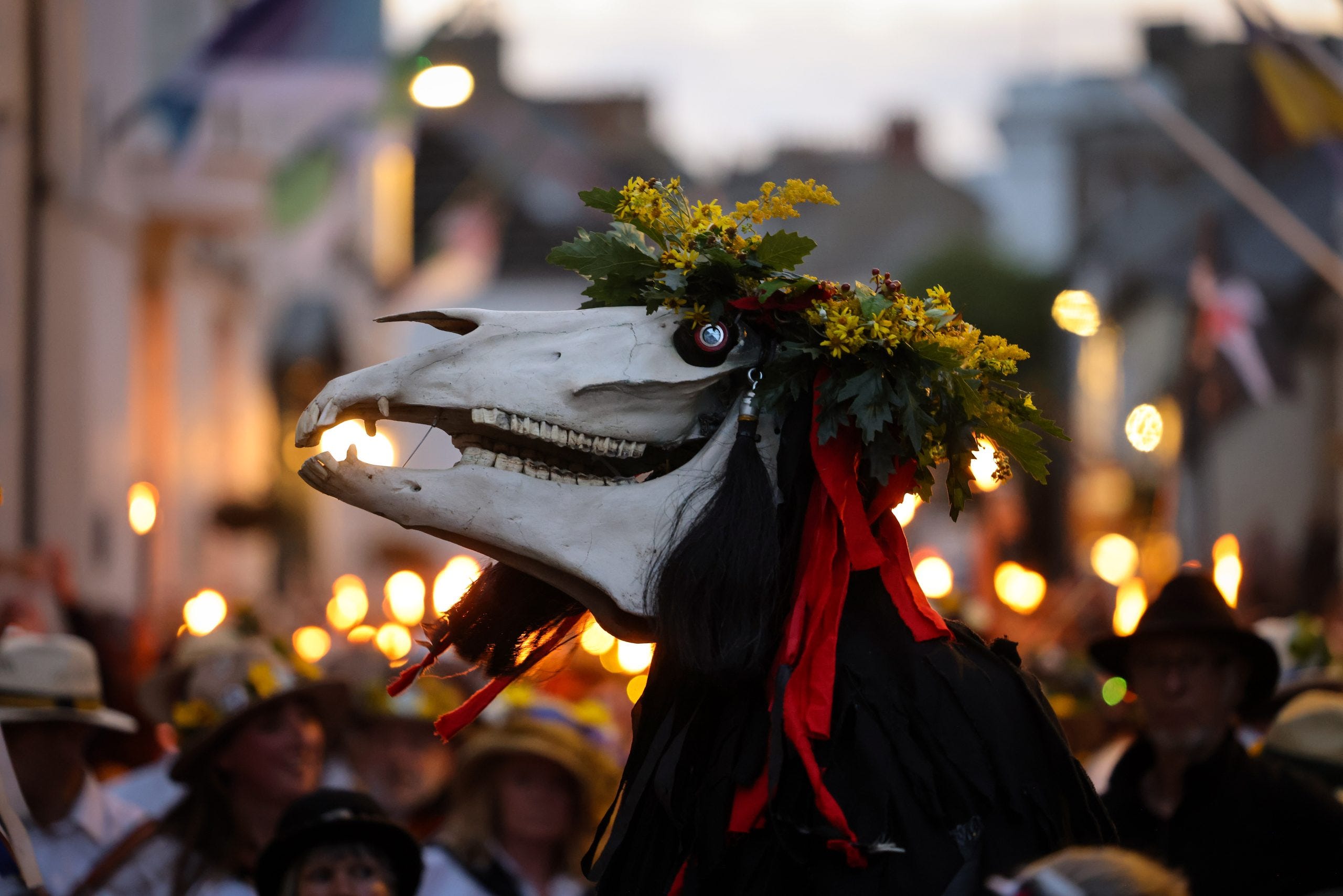
The Penzance ‘oss Penglaz.
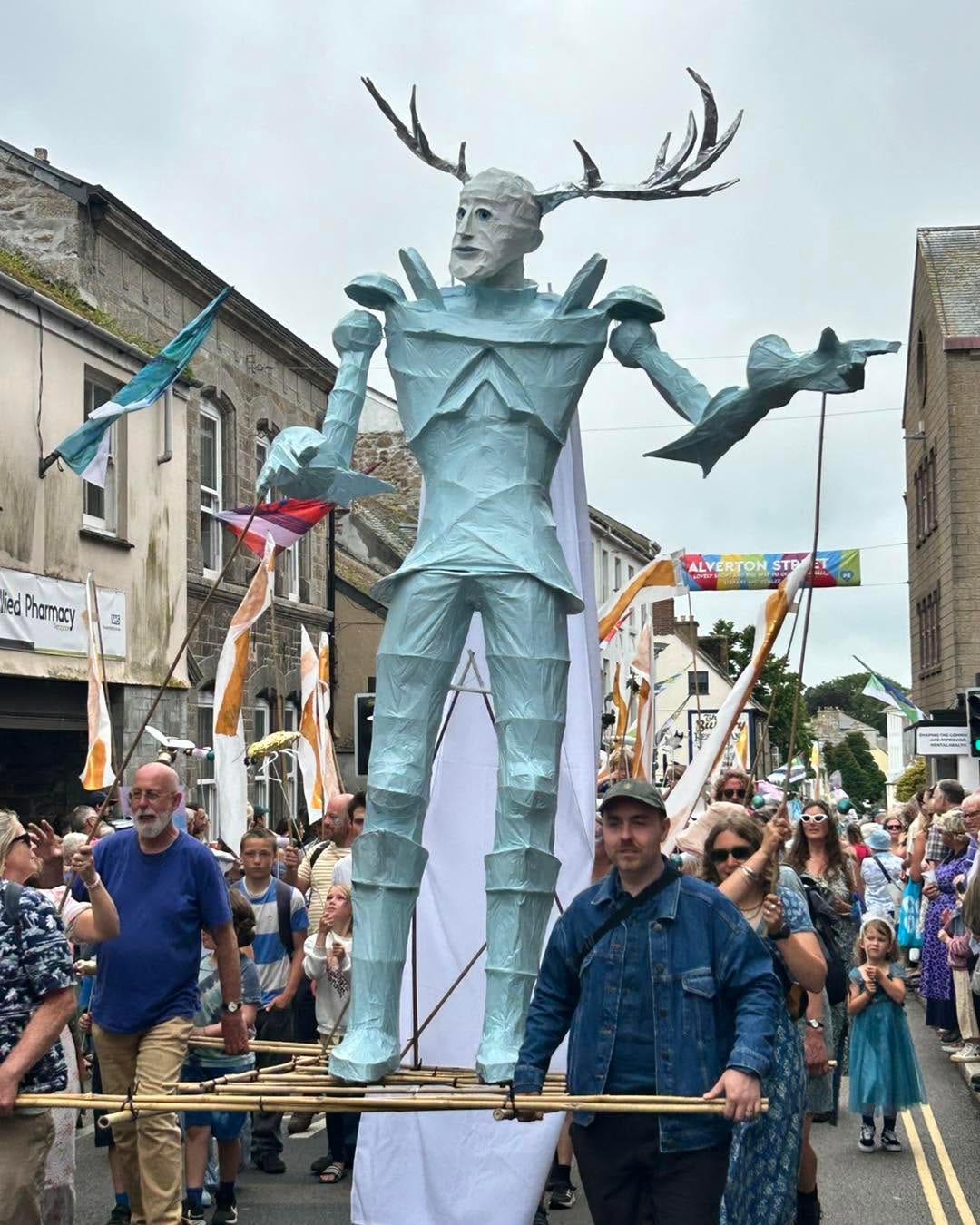
But all was not lost. The Old Cornwall Society revived the bonfire tradition across the peninsula in 1921 and in 1991 Penzance again began celebrating Golowan as a community festival. This culminates on Mazey Day with fantastic processions through the town streets of townsfolk and visitors dressed in outrageous costumes supporting huge puppets and in the evening a wonderful firework display. It’s a great day to be here.
The tar barrels rolled down the streets of Penzance in the nineteenth century would originally have been used for the storage of pilchards - now rebranded as Cornish Sardines. The last Cornish pilchard salting factory closed in 2005 but Cornish tinned sardines are delicious if you like that kind of thing. My husband loves them. I haven’t done tinned fish since a disastrous encounter with a canned pilchard when I was about ten. I kept thinking it was ridiculous to have foresworn them for so long, so about fifteen years ago I tried again - with the same unhappy result.
Fresh sardines however - fantastic. It’s the best time of year for them, especially if you can eat outside as the light fades, accompanied by the scent of barbecued fish and the distant roll of the sea. (And a crisp glass of something chilled).
So I grilled some sardines whole over my dinky little barbecue and served them with a squeeze of lemon and finely chopped fennel fronds. Oily fish always needs a fresh side dish I think and fennel is a nod to that church decorating mentioned above.
Here’s a recipe (if you can call it that) for a fennel salad.
I sliced a couple of fennel bulbs very thin, then soaked in iced water for a couple of hours - this makes a massive difference to fennel - it makes it really crunchy. I made a dressing by lightly browning a clove of garlic in some good olive oil, discarding the garlic and added a tablespoonful of broken walnuts, I added a teaspoonful of cider vinegar and seasoned well then I poured it still hot, over the fennel .
‘Midsummer midnight skies,
Midsummer midnight influences and airs,
The shining, sensitive silver of the sea
Touched with the strange-hued blazonings of dawn;’
From ‘Midsummer Midnight Skies’ by William Ernest Henley (1849-1903)
Notes
*From a Bonham’s catalogue :
“John Mirk, who flourished either side of 1400, was an Augustinian canon and later prior of Lilleshall in Shropshire. The Festial, a collection of sermons for the use of parish priests, was written in the last quarter of the fourteenth century, and contains hostile references addressing the contemporary threat from Lollardism."
William Caxton printed copies of ‘The Festial’ in 1483
xx Liz
Fab bonfire paintings...the first reminded me of 'Portrait of a Lady on Fire' 😍
Living near the sea in the south of England, these traditions feel less like history and more like something that never fully left. The tar barrels rolling down the streets of Penzance at midsummer are not so far from the bonfires on the hills of my own Italian childhood. The fire is always the same fire.