
'Rhubarb Rhubarb...'
Thoughts on a seasonal delicacy (and a gluten free sponge).

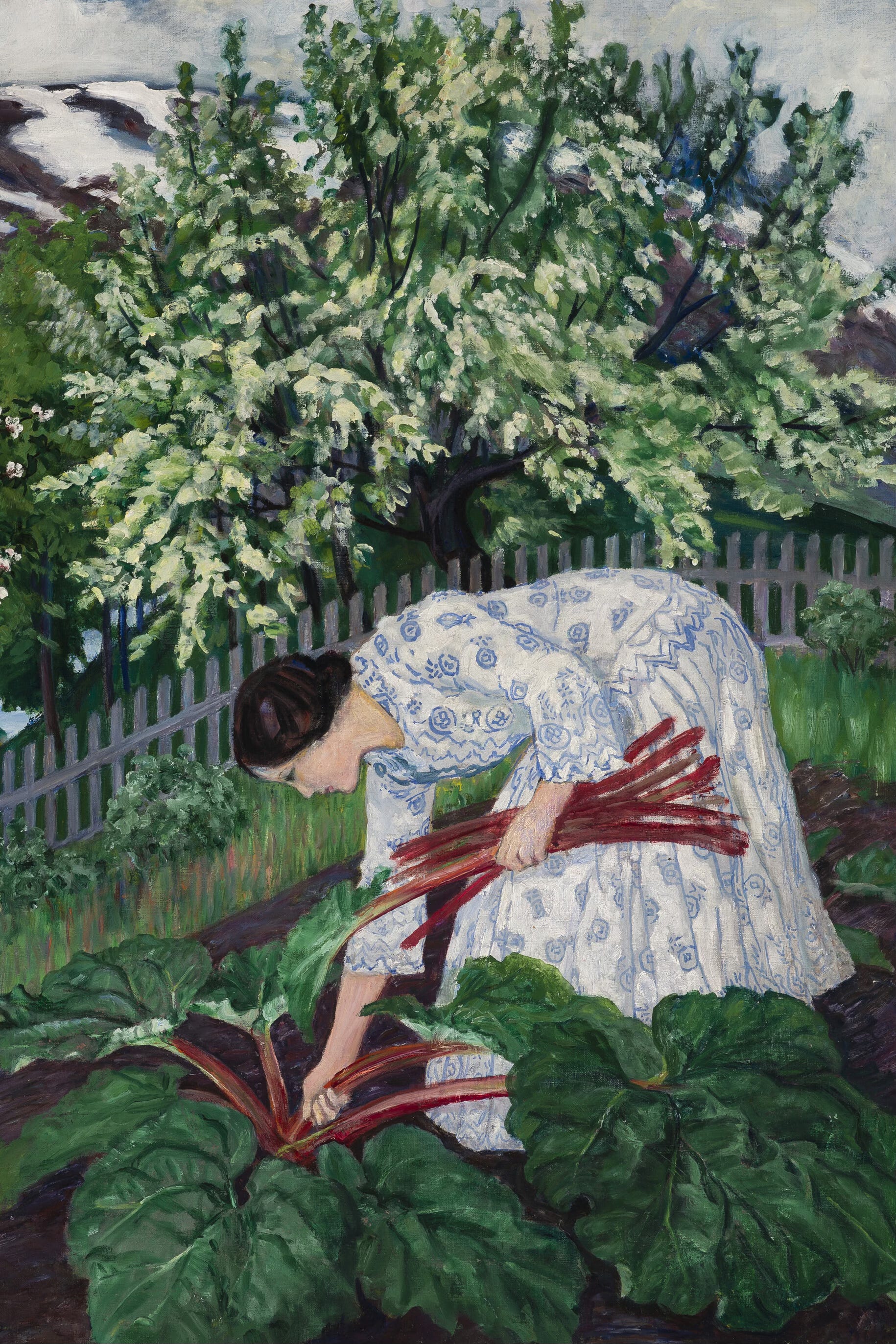
Nikolai Astrup (1880-1928) ‘Rhubarb’ 1911*‘
When I was growing up my mother was obsessed with the state of the family digestion. At breakfast time, regular updates were demanded as to the state of play and any suggestion of lack of activity was ruthlessly tackled by making us eat a battalion of foods with ‘roughage’. All Bran, bran flakes, wholemeal bread, prunes and rhubarb were instantly placed on the menu. Murmurs of rebellion were quashed with a stern reminder of the many children who didn’t have our privileges. It still makes me feel guilty every time I eat white bread.
Rhubarb was the most palatable of these moveable feasts and it’s still one of those spring delights that I look forward to, especially when baked with blood oranges or a punnet of those rather hard and disappointing winter strawberries.
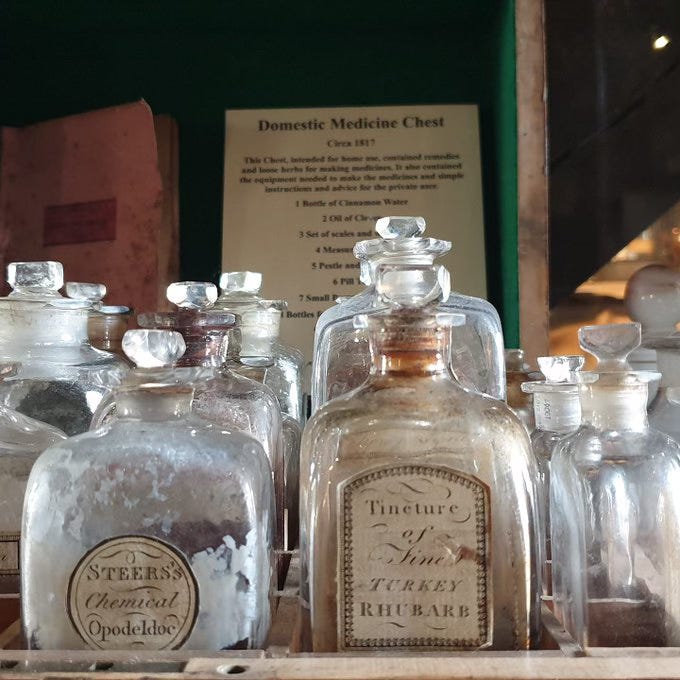
Rheum rhaponticum was grown in England in the 16th century as part of the routine contents of the home physick garden - it was the root that was used as a purge. Later through hybridisation and the availability of sugar, the stalks became the domestic rhubarb we now eat as a dessert. Interestingly the ‘barb’ part of the word is connected to ‘barbarian’ . The Greeks called rhubarb - ‘rha barbaron’ - ‘foreign from the area of the River Rha’ which was the Volga.
There is a fascinating piece by Nathan Cornish about the history of rhubarb as medicine here - from the Old Operating Theatre Museum at St Thomas’s Hospital.
The best quality Rhubarb between 1657 and the early 1860s came through Russia. This was subject to a monopoly of the Tsar until 1781. Even the Tsar’s officials had no real idea of where the rhubarb came from because they bought it from nomadic merchants at Kiakhta who imported it themselves.
https://oldoperatingtheatre.com/gold-silver-and-rhubarb-britains-mystery-wonder-drug-that-became-its-favourite-pudding/
Much of the forced English rhubarb currently the shops comes from the Yorkshire Rhubarb Triangle which is centred around Wakefield. The chilly northern winters suit a plant that has its origins in Siberia and the historic availability of shoddy (recycled textile waste) traditionally meant that the roots could be placed in sheds and forced in complete darkness. The shoddy, and ‘night soil’ from the emptying of earth closets (before mains drainage was introduced into the industrial towns) made a fertile compost that turned a humble northern root into a premium product. It strikes me that there’s a satisfying element of circularity in that old method. (Sorry)
This RHS video turns rhubarb picking into art.
Yorkshire rhubarb is still picked by candle light because anything brighter will stop the forcing process. Jane Grigson in her Fruit Book makes no bones about the fact she can’t stand rhubarb but she admits that forced rhubarb has its admirers. Once the stalks are green, she says it should be avoided at all costs.
We’ve just come back from a couple of days away in the Welsh borders and at a very lovely country pub in Herefordshire, I had a dessert of woodruff flavoured panna cotta with lavender and honey ice cream and a couple of slivers of poached rhubarb. It was ambrosial. However, it’s taken a long time for rhubarb to hit the gastronomical high spots. If I look at the indexes of the cookery books on my shelves, those of so called ‘posh food’ rarely mention rhubarb. Like gooseberries, for a long time rhubarb was seen as a working class northern fruit (well - not a fruit but you know what I mean) and its association with costiveness relegated it to ‘food as medicine’ status.
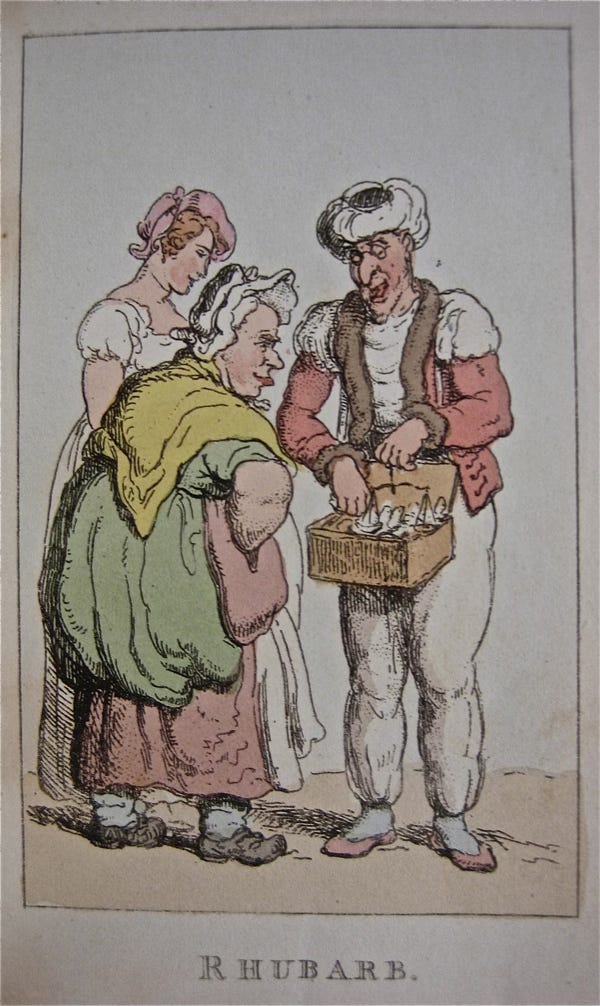
Thomas Rowlandson ‘Characteristic Sketches of the Lower Orders’ 1820
Rhubarb root for purgative purposes was commonly sold by street vendors who often dressed in Turkish costumes to draw attraction to their wares.
This isn’t a comprehensive or scientific survey by any means but there is no mention of rhubarb in Agnes Jekyll’s ‘Kitchen Essays’ (1922) or the wonderful ‘Gentle Art of Cookery’ by Olga Leyel and Dorothy Hartley published in 1925. My 1890 edition of Mrs Beeton has one recipe for a rhubarb tart and another for rhubarb and orange jam. Florence White’s ‘Good Things in England’ (1932) has just one recipe and that’s for preserving rhubarb - presumably so that a ‘dose’ could be given at any season.
Rhubarb was really popularised in the Second Word War during the ‘Dig For Victory Campaign’. Marguerite Patten’s war time recipes (published as a collection in 1995), make much of rhubarb; including crumble, crisp, pudding and cake. Rhubarb was easily grown, nutritious, preservable and off ration. Eat as much as you like, as long as you had something to sweeten it with. If you grow Sweet Cecily, a handful of the herb in stewed rhubarb can reduce the amount of sugar you need. Vanilla works in the same way (try it in stewed apple).
By the way the expression “rhubarb rhubarb’ was traditionally used as a phrase when doing sound checks. It’s soft notes made is suitable for such a purpose and the usage has come to mean nothing or nonsense - as in ‘a load of old rhubarb’, one of my other half’s favourite sayings.
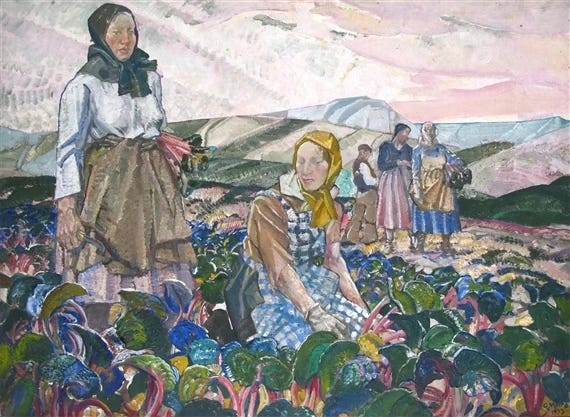
The Rhubarb Harvest’ by Gerald Moira (1867-1959)
Anyway, enough rambling. Let’s make something.
Gluten free rhubarb sponge pudding.
This is loosely based on Jane Grigson’s recipe for rice cake in ‘English Food’. I’m giving it to you exactly as I made it.
Oven 170c Fan. I used a 9” cast iron baking pan lined with baking paper
For the base
½lb thin stalks of young rhubarb chopped into ½ inch lengths
6 large strawberries sliced
50g arrowroot powder (or cornflour)
Rind and juice of half an orange
2 tablespoons of sugar
Mix together in a bowl and set aside.
For the sponge topping
8oz ground rice
½ tsp gluten free baking powder
Pinch of salt
4oz soft butter
3 large eggs beaten
Rind and juice of the other half of the orange
8oz caster sugar (I used about an ounce less)
Handful flaked almonds
Cream the butter and sugar until pale cream in colour and fluffy
Tip in the eggs, ground rice, baking powder, salt and orange juice /rind
Beat briefly until mixed together.
Put the rhubarb mix in the bottom of the pan, press down and spoon over the sponge mixture. Sprinkle with almonds. Bake for about an hour ( I baked for 50 mins and it needed a bit more)
Serve warm.
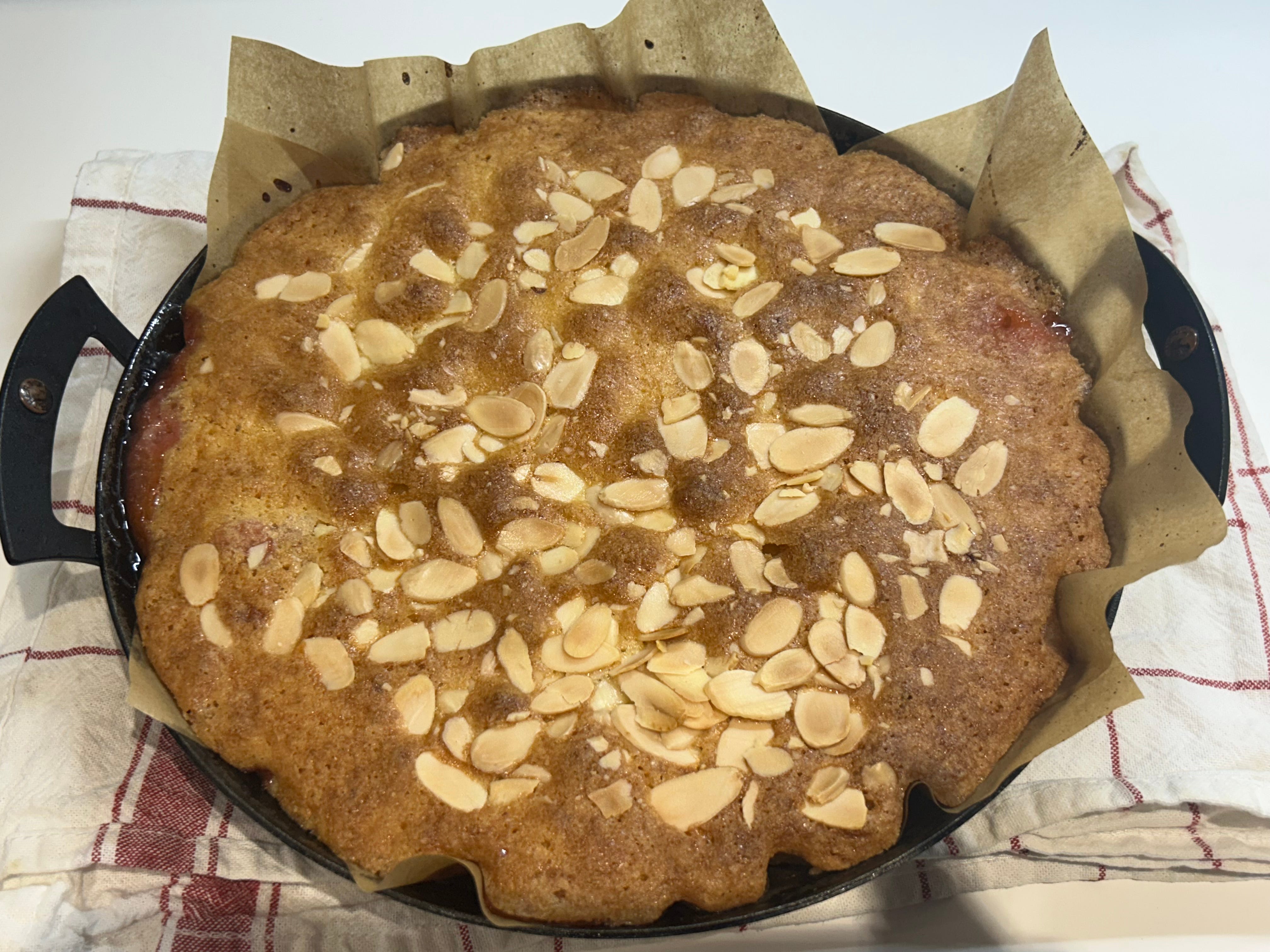
It was a very delicious dessert on a damp Cornish day.
See you next week.
x Liz
Notes
*Oil on canvas, Foundation DNB/The Astrup Collection/KODE Art Museums of Bergen. Photo © Dag Fosse/KODE, detail
Thanks for this very interesting post! I love rhubarb with a dying love. We had strawberry rhubarb pies when I was growing up, but I see no need for the strawberry! Now I make rhubarb custard tarts (and rhubarb gin 🤷🏻♀️) whenever the rhubarb appears. I also cook it an freeze it in batches to last all year.
What a wonderful load of rhubarb 😋 I really like the stuff, especially in a crumble, so it's great to learn more about it. My parents used to grow it in their garden, so this brings back lots of memories. Thank you, Liz!