
St Piran’s Day
A proper Cornish festival and a very improper pasty

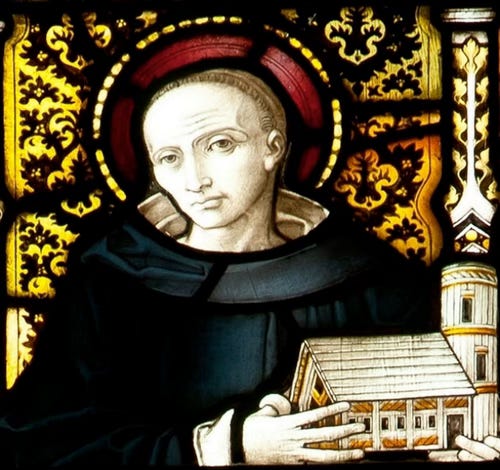
Window image of St Piran in Perranzabuloe Church
‘The fairest flowers, the richest veins of ore,
The brightest gems, the costliest specimens,
The grandest, greatest, meekest, noblest minds,
Are often shining in this darksome world’
John Harris (1820-1884) ‘A Story of Carn Brea’
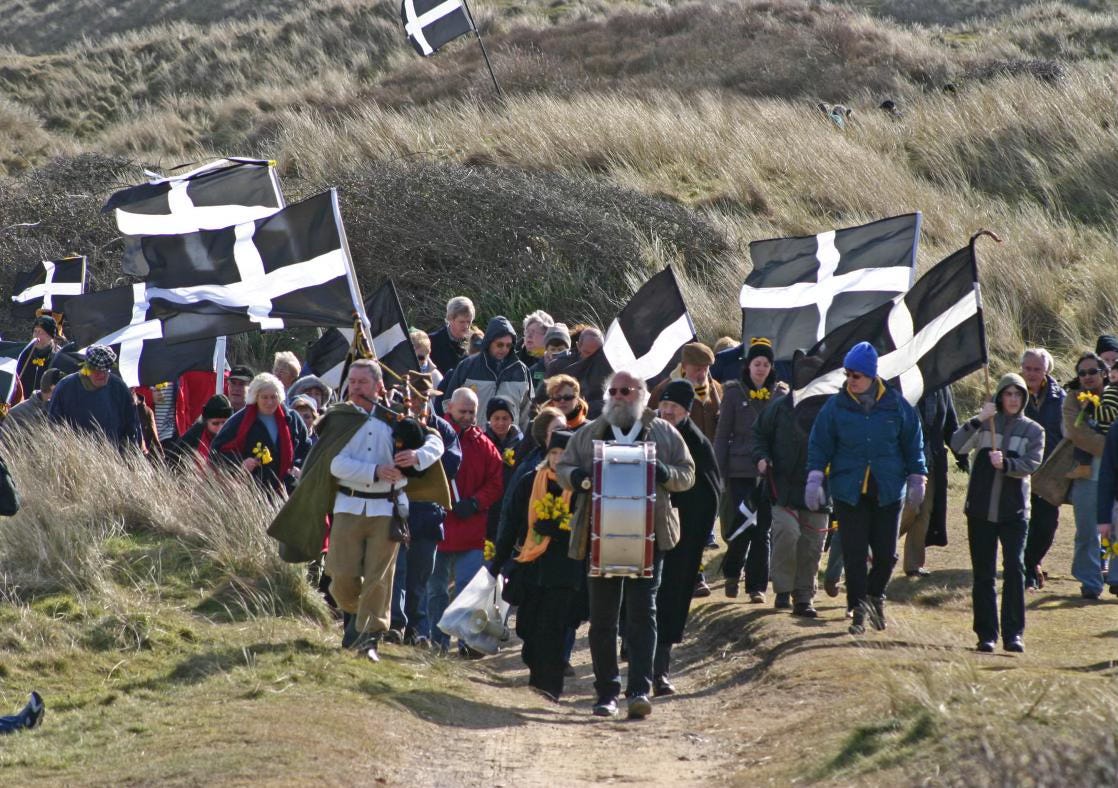
It’s St Piran’s Day here in Cornwall. School children are marching, bands are playing, and Cornish flags are everywhere.
Before we moved to West Penwith, I had no idea that St Piran was such a big deal in Cornwall. As with so many Celtic saints, the details of his life are a mixture of hazy memory, dubious fact and active imagination. Whether St Piran was also St Ciaran of Ireland we really don’t know, their two lives may have been conflated by historians in the past. Saint Piran is said to have been a 5th century Irish abbot who was tied to a millstone and cast into the sea, possibly under orders of some Chieftain.
Miraculously, Piran floated across the Irish Sea to Perranporth on the north coast of Cornwall, where he built an oratory. Local legend says that his first disciples were a badger, a bear and a fox, so Cornish children often dress as animals for the parades.
What we do know is that the cult of St Piran began in Perranzabuloe in the 10th century and the early St Piran’s chapel now buried in Perran Sands, dates from that time. St Piran is also the saint of the parish churches of Perranworthal and Perranuthnoe where there was a guild of St Piran in 1457.
The main reason for St Piran’s popularity though, is that he is the patron saint of tin miners. John Harris the poet quoted above, was a miner before he became both a poet and a preacher. Parades by tinners showing off the saint’s relics may have lead to this connection and his feast day on the 5th March was a traditional holiday for Cornish miners.
The cost book of Great Work Mine near Breage says that in the mid 18th century there was an allowance for Perrantide for every man and boy working there. St Piran’s flag, the standard of Cornwall shows a white cross on a black background, symbolising the triumph of good over evil and the tin metal trapped in the ore. As Catherine John says in her book ‘The Saints of Cornwall’ such connections may have developed later but are nevertheless not without value. *
I only make Cornish pasties about once a year. Meat with pastry is not my favourite combination and anyway you can buy a very decent pasty in every town in Cornwall. Pasties are nonetheless still made in many Cornish kitchens very regularly, and quite right too.
Let’s deal with all the pasty myths first. The Cornish pasty developed as portable, hot and sustaining food for a tin miner. Made in the morning (or more likely baked overnight in the bread oven) its pastry case would keep the contents warm until the lunch break and the disposable pastry crimp round the edge meant a man could eat it with dirty hands. It did not have apple at one end and meat at the other. Its filling is beef; usually skirt, with potato, onion and swede, butter and lots of seasoning – nothing else. And never, never, is the beef cooked before it is put into the case. Do you hear that Nigella?
The days you can get cheese and onion pasties as an alternative to meat (see below) but in the days when every Cornish housewife made pasties, they were filled with whatever was to hand. The old legend is that the Devil never crossed the Tamar for fear of being clapped in a pasty. So there are lots of old pasty recipes with fillings made with anything from pilchards to potato.
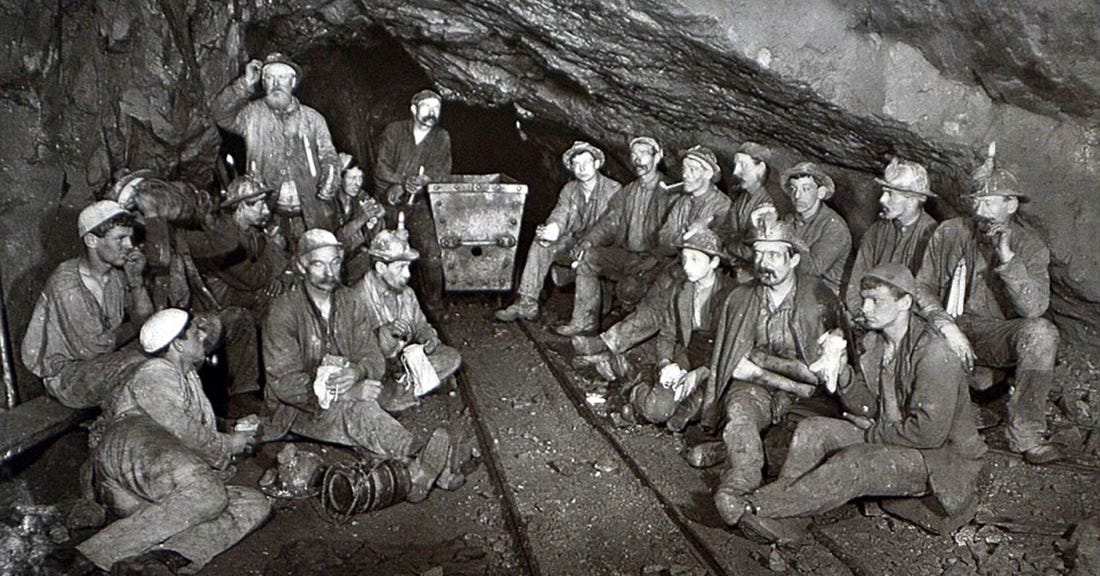
Once down the mine the pasties were kept hot in a bucket suspended over a candle and eaten straight from the wrapper - often a little cloth bag. Here’s what a ‘croust’ (lunch break) looked like down a mine.
The identification of each pasty by marking it with initials is traditional. The initials can either be pricked in the pastry with a skewer or made from the scraps of paste left over and stuck on. This even happens for pasties made at home – each then can be tailored to the taste of different members of the family.
I was messing about in the kitchen and thinking about vegetarian pasties when a jar of feta cubes in oil stared at me from the cupboard. This was the result.
Little Feta and Olive Pies
350g jar of feta cubes and stuffed olives in oil
350g flour with a pinch of salt.
I bunch spring onions
Egg to seal and glaze
Drain the feta and olives over a bowl and measure the oil that drains through. You need 150ml. Chop the spring onions and sauté lightly in a little oil. Leave to cool.
Mix the 150ml of the reserved oil with the flour and salt, then add sufficient water to be able to draw it together in a ball. I used a couple of tablespoons. It’s a very short pastry and tricky to roll, so do that between two sheets of baking paper. Cut out saucer sized circles.
Mix the cheese and olives with the onions and spoon onto the pastry circles. I chopped the cheese and olives a bit smaller than they came out of the jar. Fold or sandwich together and glaze with egg. Bake for 25 minutes at 190c.
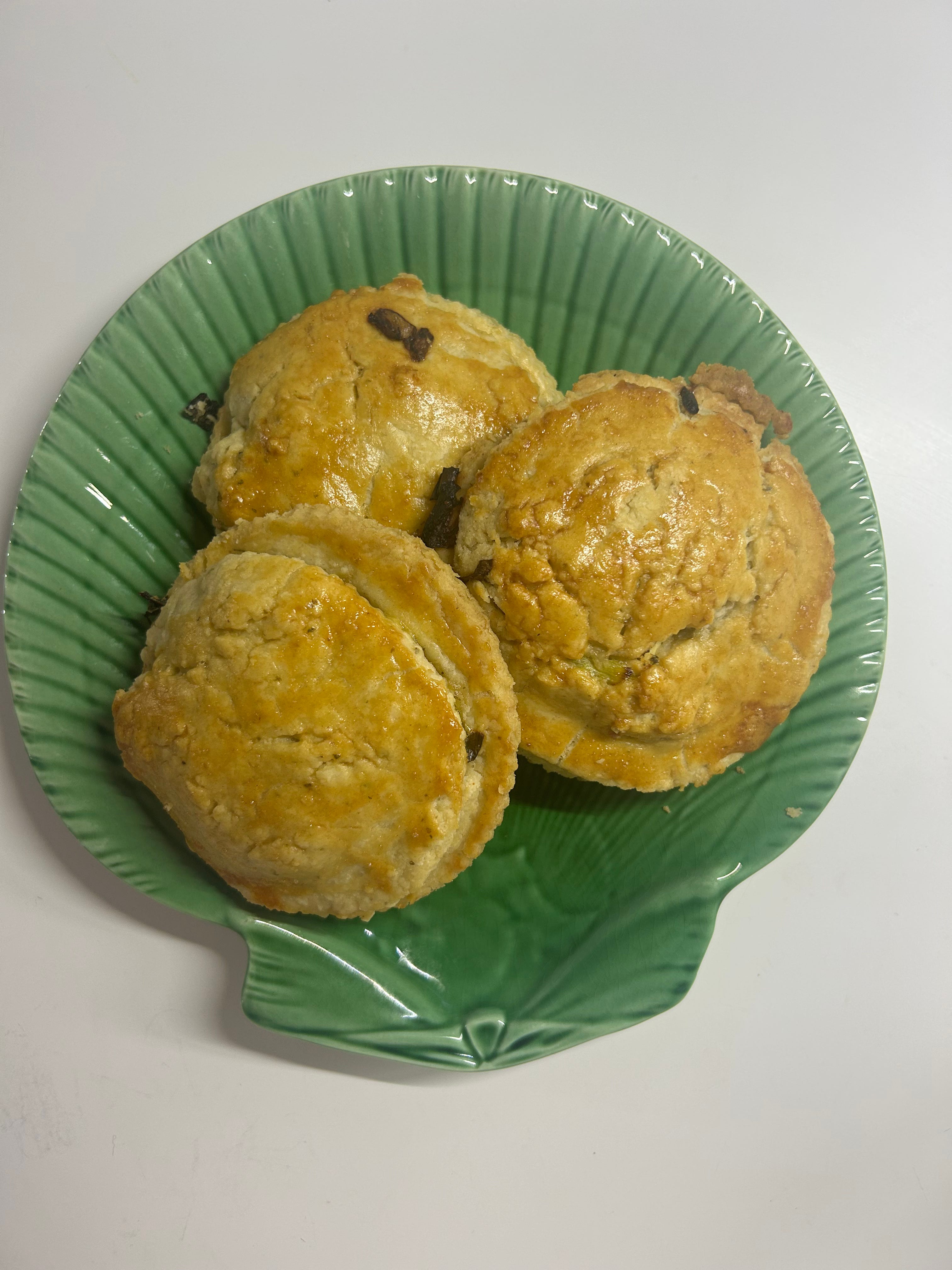
I didn’t make my circles big enough, and in the interests of the right ratio of filling to pastry, I gave up trying to fold them over and made little pies instead. They were very nice eaten lukewarm with smoked tomato ketchup, but tzatziki or whipped feta would be good too. I’d have made a tomato salad if I’d had time but I didn’t.
‘Now telle on Roger, looke that it be good
For many a pastee hastow laten bled’
Geoffrey Chaucer (c1343-1400) From the prologue to ‘The Cook’s Tale’.
Notes
*See also: ‘The Saints of Cornwall’ by Nicholas Orme OUP 2000
Have a good week. More next.
x Liz
Fascinating, Liz! and "Perrantide" has a lovely ring to it.
As a Devonian, I'm honour bound to say that some from my county claim its pasties are not only better but also have a longer lineage. However, I'm far from being a chauvinist in such matters and enjoy a Cornish pasty as much as the next person.
Proper job right there.
Happy St Piran’s Day from the Tamar Valley (cream first side!)