
Swanning around…

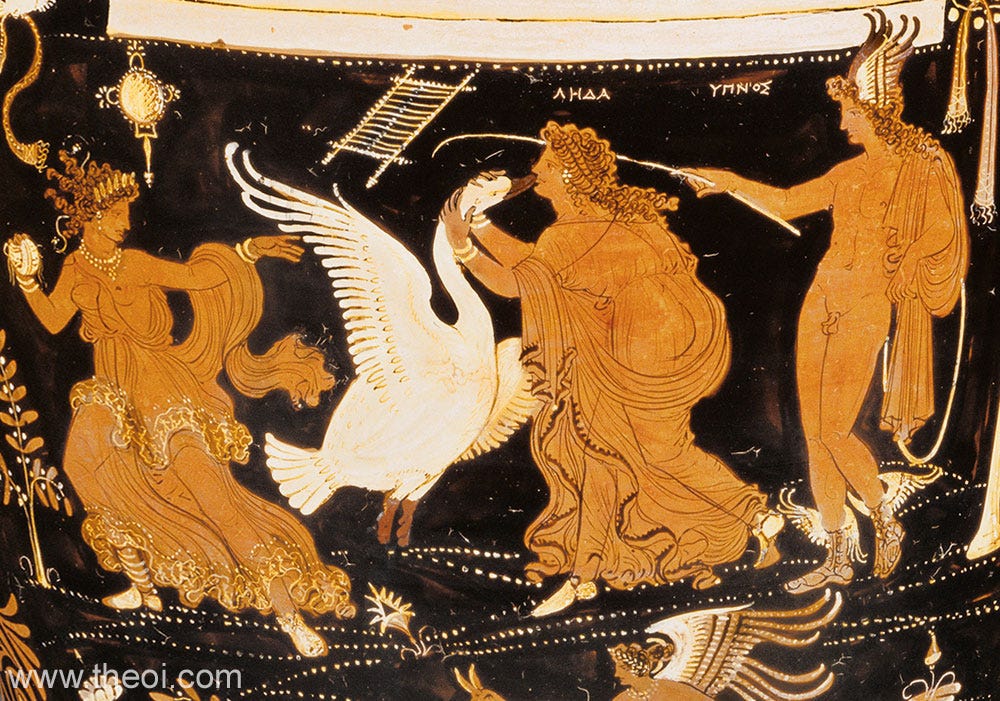
Greek Vase image of Leda and the Swan c 350BCE
I have looked upon those brilliant creatures
And now my heart is sore
All’s changed since I, hearing at twilight,
The first time on this shore,
The bell-beat of their wings above my head
Trod with a lighter tread.
From ‘The Wild Swans at Coole’ by W B Yeats (1865-1939)
I read and re-read all of Hans Anderson’s stories as a child and absolutely loved them even though some of them like ‘The Tinder Box’ scared me in a good way. Do children still read them? I do hope so.
Apart from ‘The Snow Queen’ which is deeply embedded in my memory, the tale I loved the most was ‘The Wild Swans’. What occurs to me now, is that both of those stories are about girls rescuing boys who have been bewitched. As Angela Carter would probably have pointed out, women were doing missionary work for men even in fairy stories. As a kid I simply saw them as tales about courageous girls going on quests and that is still my main take away.
Anyway, I’ve been thinking about swans. I do know someone who actually has a swan-phobia, but I just love their fierce beauty.
The Greek vase image above is of the seduction of Leda by Zeus disguised as a swan. Helen of Troy the most beautiful woman in the world was the result of the union (apparently she hatched out of an egg) and swans have long been a by-word for grace and strength. Does anyone know what that frame thing is above the swan’s head?
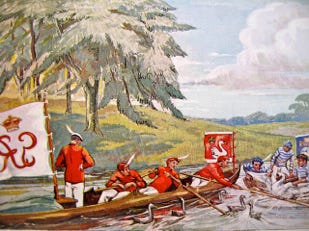
It’s a popular myth that all swans in Britain belong to the King. They don’t actually - it’s only unmarked Mute swans living on open water that do. The King is the ‘Seigneur of the Swans’ and every July his swans on the Thames are counted and health checked. This is the ancient ceremony of ‘Swan Upping’. The King’s official Swan Marker carries out the check on his behalf and on behalf of of two Worshipful Companies; the Dyers and the Vintners, who were granted joint ownership with the Sovereign as far back as the fifteenth century.
The King’s Swan Marker David Barker, the Royal Swan Uppers and the Swan Uppers of the Vintners’ and Dyers’ livery companies, all wearing their distinctive red livery, row six traditional Thames skiffs from Sunbury Lock to Abingdon Bridge. It takes five days and all the swans on the river are checked for their general health and wellbeing and new cygnets are ringed.
The eating of swan has never been common, but it was something that would have crowned an important feast. The kitchens at Hampton Court being as they are, very close to the Thames, were one of the places roast swan was prepared and served. Another was in the stupendous sixteenth century dining hall of St John’s College in Cambridge, which had a special dispensation from the monarch to serve swan on important occasions. St John’s has on its outer walls, which adjoin the River Cam some (now happily disused) swan traps.
Here’s what the ‘Forme of Cury’ written in about 1390 says about how to cook a swan.
For to dihyte a swan. Tak & vndo hym & wasch hym, & do on a spite & enarme hym fayre & roste hym wel; & dysmembre hym on þe beste manere & mak a fayre chyne, & þe sauce þerto schal be mad in þis manere, & it is clept Chaudon.
The chaudon is a sort of sauce made from the blood and guts of the bird. The neck of the swan was served separately in the same way as country people in France still serve the necks of geese, stuffed and braised.
The music for the cantata ‘Carmina Burana’ was written in the 1930s by the German composer Carl Orff. Orff set to music the words of a collection of Latin poems by the same name. They were written by wandering scholars in the 11th and 12th centuries and many are drinking songs, some witty, some naughty and one about a poor swan about to be roasted.
Once I had dwelt on lakes, once I had been beautiful, when I was a swan. Poor wretch! Now black and well roasted!
The cook turns me back and forth; I am roasted to a turn on my pyre; now the waiter serves me. Poor wretch! Now black and well roasted!
Now I lie on the dish, and I cannot fly; I see the gnashing teeth. Poor wretch! Now black and well roasted!
The music is appropriately screechy at this point!
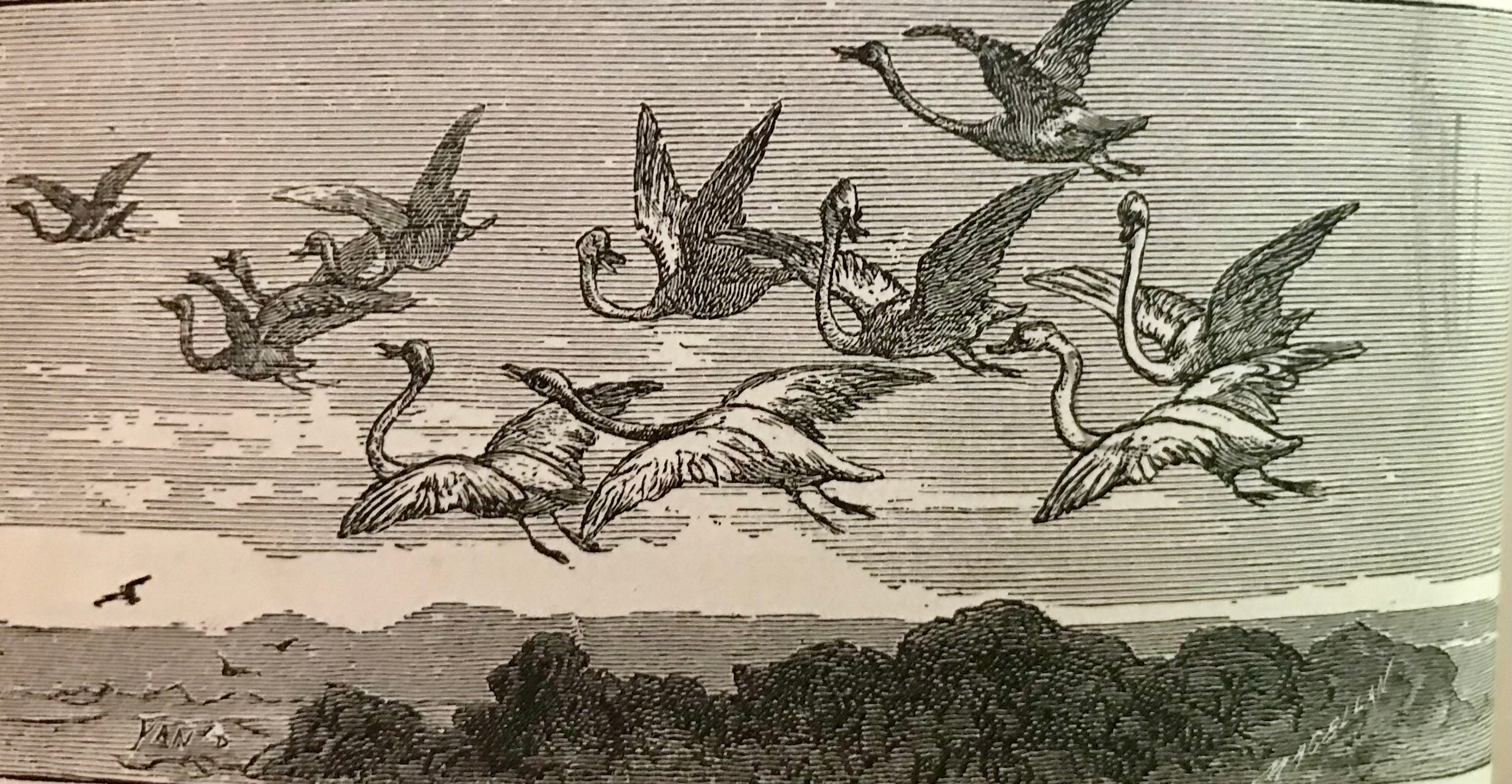
Illustration by Susanna Paull from her translation of Hans Anderson published by Frederick Warne and Co c1900.
Of course all swans are now protected by the Wildlife and Countryside Act, which prohibits the taking of eggs or the killing of birds but sadly low flying swans are often victims of power lines. Whooper swans migrate from Iceland to the Orkneys every winter and they are sometimes electrocuted in flight and fall to the ground undamaged but very dead.
The correct procedure when you find a dead swan is to report it to the local RSPB warden who will then tell you how to dispose of it, but this is only a recommendation and it is not a legal requirement.
Years ago I briefly met the then Master of the Queen’s Music, Sir Peter Maxwell Davies. Max came home one day to his house on the Orkney island of Sanday and was surprised to find the police there to question him about a dead swan they had spied hanging on his property. Max then offered them a slice of swan terrine - big mistake! Apparently you hang a dead swan for four days before you roast the leg and breast meat. If the swan is already dead this is perfectly legal - just like eating roadkill.
The police weren’t happy either about two swans wings that Max had in his shed. They weren’t convinced these were drying so they could be used for angels wings in Sanday school’s nativity play….
After consulting with the RSPB and realizing that the eminent composer always informed them when he found a dead swan, no further action was taken, but there were red faces at the Constabulary.
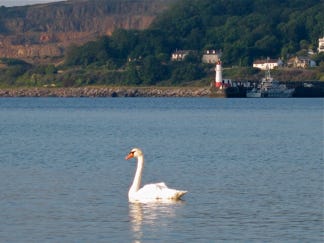
My photo of a swan in Mount’s Bay about 2016
Don’t worry I’m not going to eat swan and I draw the line at road kill. The swans on my river are much depleted since an outbreak of bird flu a couple of years ago and anyway I think they might taste a bit fishy.
Swans made me think of rivers, rivers made me think of fresh trout and of that most British of herbs - fresh watercress. So here is a delicate trout dish.
Cold baked trout with watercress sauce
I’m sure you don’t need me to tell you how to bake a trout, but in case you do, I put my gutted trout into a shallow dish, put a knob of butter inside the fish with a slice of lemon, seasoned it and covered it with foil. I then baked it in a hot oven (200c) for about 20 minutes. I think trout is best eaten when it’s barely warm so I allowed it to cool for about half an hour before I skinned it.
The sauce is similar to a classic sauce ravigote, which is a sort of citrussy pick me up, it’s one of those delicious things that you keep tasting until you are satisfied with the balance of flavours. The ingredients are infinitely variable. This is what I used.
Watercress - about a quarter of a bag
About a tablespoon each of chopped parsley, tarragon and dill
3 spring onions
3 anchovies
1 dessertspoon of capers
A couple of pieces of pickled cucumber
Olive oil, lemon juice, a teaspoon of Dijon mustard
Chop the herbs and onions together finely. Add the chopped pickles, the finely chopped capers and the chopped up anchovies. Mix together then add a tablespoon of lemon juice and slightly more olive oil and the mustard, stir together and taste it. You might need a bit more oil or mustard and a grind or two of pepper. Leave to stand for an hour or so.
Serve over the cooled (not refrigerated) fish. I garnished the whole thing with fresh nasturtium leaves and seeds.
By the way, if you are a vegetarian, this sauce is delicious with grilled halloumi or cold poached eggs, you can just leave out the anchovies and if you wish add a little marmite with the oil... I sometimes change the herbs and add a load of mint to serve with lamb.
Not a quack, not a quack, not a waddle or a quack
But a glide and a whistle and a snowy white back
And a head so noble and high
Say who’s an ugly duckling?
Not I!
From ‘The Ugly Duckling’ words and music by Frank Loesser (1910-1969
x Liz
Was Leda weaving when she was rudely interrupted? It looks like a loom, & a spindle top left.
Swan Lake still bewitches me, even after seeing it many times. Both the beauty and the strength of the bird come through in the ballet. And whenever I pass Dawlish on the train, I crane my neck for a glimpse of the black swans there.