
A Flight to Egypt...
Memories of a previous life.

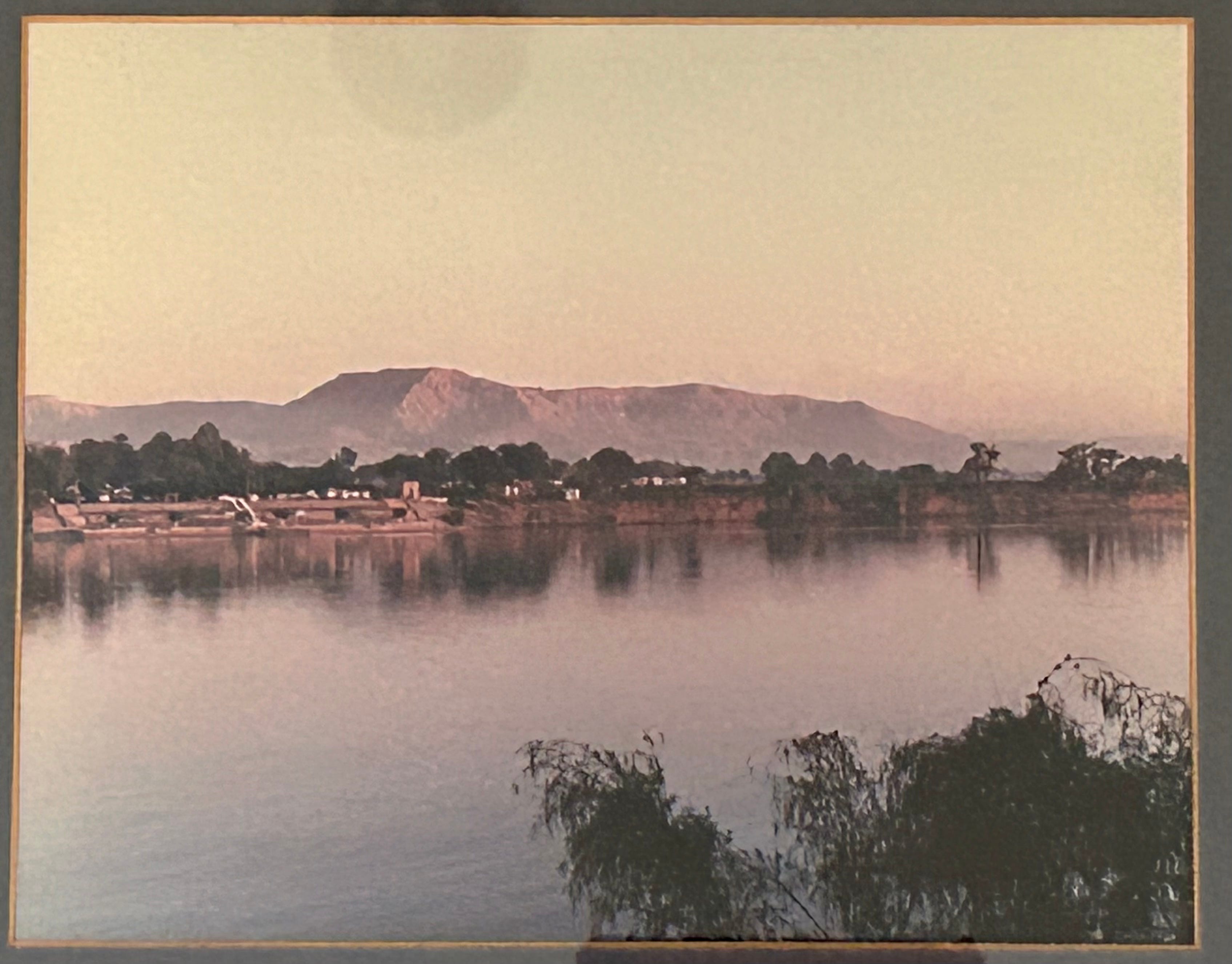
An April dawn looking towards the Valley of the Kings. Photo by me. Early 1980s.
…..Hermits upon Mount Meru or Everest,
Caverned in night under the drifted snow,
Or where that snow and winter’s dreadful blast
Beat down upon their naked bodies, know
That day brings round the night, that before dawn
His glory and his monuments are gone.
From ‘Meru’ by W.B Yeats (1865-1939)
A long time ago I went to Egypt. I had very mixed feelings about it. It’s a country of mind bending contrasts. So many tourists in Egypt are ushered from cool marble hotels into air conditioned buses. They are then briefly decanted to see the sights before retreating back into insulated comfort. We didn’t do that and although it was very uncomfortable at times, I did feel I saw the country and not just the extraordinary antiquities. However it was my first visit to Africa and it was a shock. My father lived in Egypt for a time; he loved it and I expected to do the same but it took me a while to get my head and my heart around it.
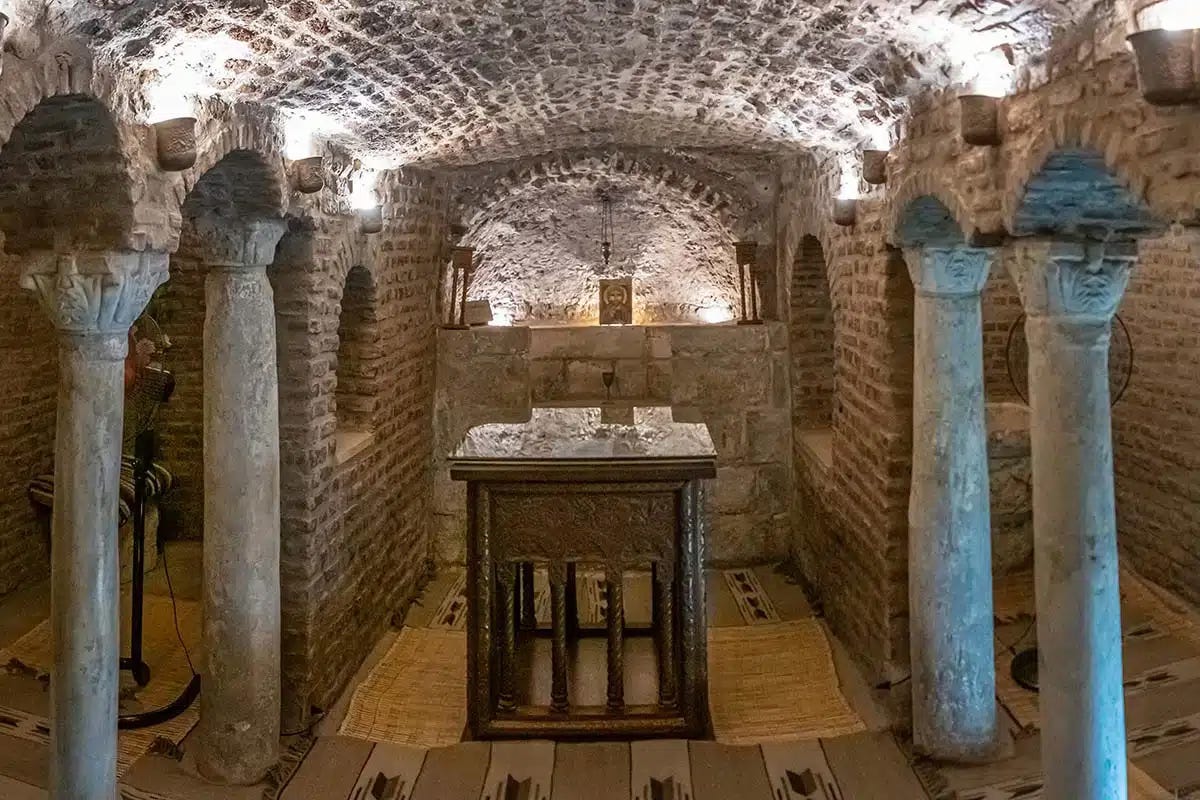
On the last day of the trip which took us from Alexandria to Aswan by train and bus, we visited the Coptic Churches in Cairo - some of the most ancient places of worship in Christendom. As a non believer what I mostly remember forty years later, is their unique atmosphere. After two thousand years it felt as though the bricks themselves had taken on an aura of wise contemplation. In the Church of Saint Sergius and Bacchus we saw the spot where the Holy Family was supposed to have rested on the Flight into Egypt. This is the beautiful crypt built around the cave where the family is said to have stayed. It still makes me think of the plight of refugees who have no such sanctuary.
St Anthony the Great, whose feast day is the 12th January, was a Coptic Monk born in Egypt about 250 AD. He is regarded as the founder of ‘desert monasticism’ - a branch of ascetic Christianity rooted in the hermit tradition. The Desert Fathers practiced what came to be known as ‘hesychasm’ a Greek word meaning stillness, rest, quiet and silence. After fighting my way through the crowds of Cairo, I found that very appealing.
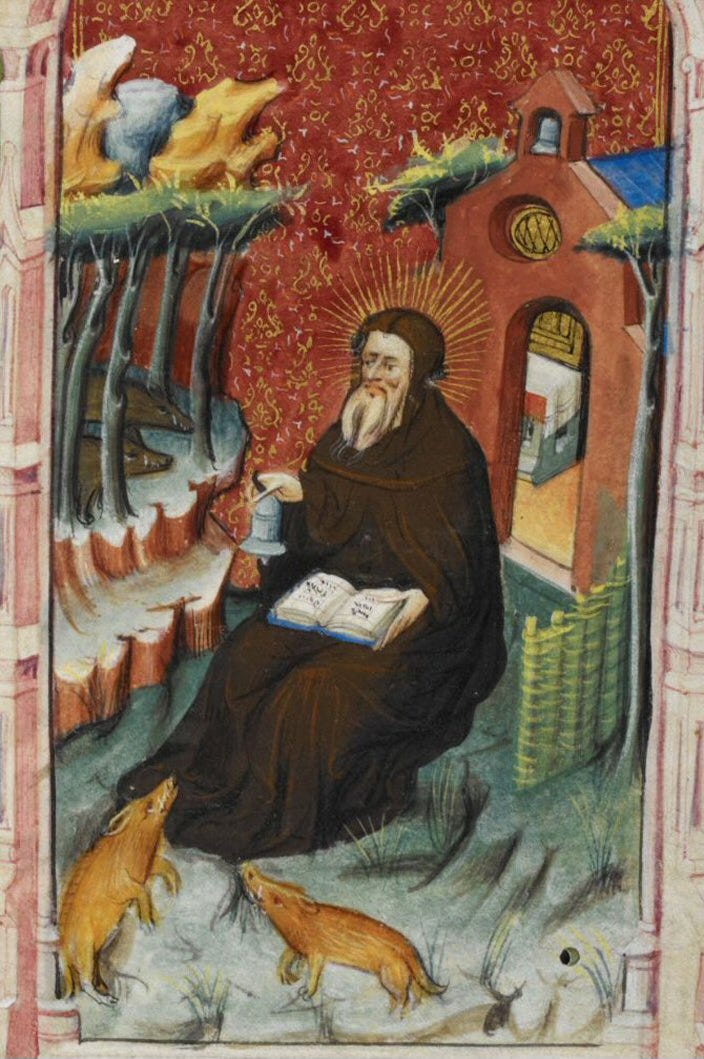
There was (and is) a tradition that the Coptic contemplative life is open to men and women from all walks of life. One story has St Anthony as having spent time as a swineherd and his symbols of the pig and the bell reflect this and his life as a monk. Here he is with his pigs in an ancient effigy now in the north transept of St Mary’s Church, Barnard Castle.
What St Anthony is mostly associated with though is the disease erysipelas, more commonly known as St Anthony’s Fire. Erysipelas is a nasty bacterial infection that makes the skin go red. The monks of St Anthony’s Monastery were particularly skilled in its cure - I suspect that they had developed an early form of antibiotic possibly from desert plants. Some sources say that ergotism is also associated with St Anthony’s Fire but whichever condition it was, it sounds like the Coptic monks of St Anthony were exceptional healers.
One of the most distinguishing features of the Coptic Church is its fasting tradition. Orthodox Copts fast for about 200 days a year. Almost every Wednesday and Friday, for long periods at Advent and Lent and during something called the ‘Jonah Fast’ - which represents Jonah’s time in the whale. Their diet at this time is very simple – a little rice, a few pulses, vegetables, maybe a little spice.
I really liked Egyptian food. I was a vegetarian back then and contrary to all the conventional advice, we ate salad and street food and we weren’t ill at all. My favourite things were the little paper cones of spicy, creamy ful mesdames that you could buy on street corners, the delicious tahini with flat bread that was a starter for virtually every meal and beautiful French omelettes that we were often given when the rest of the party were toying with indifferent and unidentifiable meat.
In Aswan it was so hot the air felt antiseptic. Just outside our hotel, I saw a man taking a baby crocodile for a walk down the street - on a lead like a Labrador. I looked this up just now and discovered it is actually a thing. The Nubian villagers who live near Aswan keep baby crocodiles as pets until they grow too large, then they are released back into the wild or mummified and displayed in village homes. I thought I might have misremembered but it is a practice that goes back to Ancient Egypt.
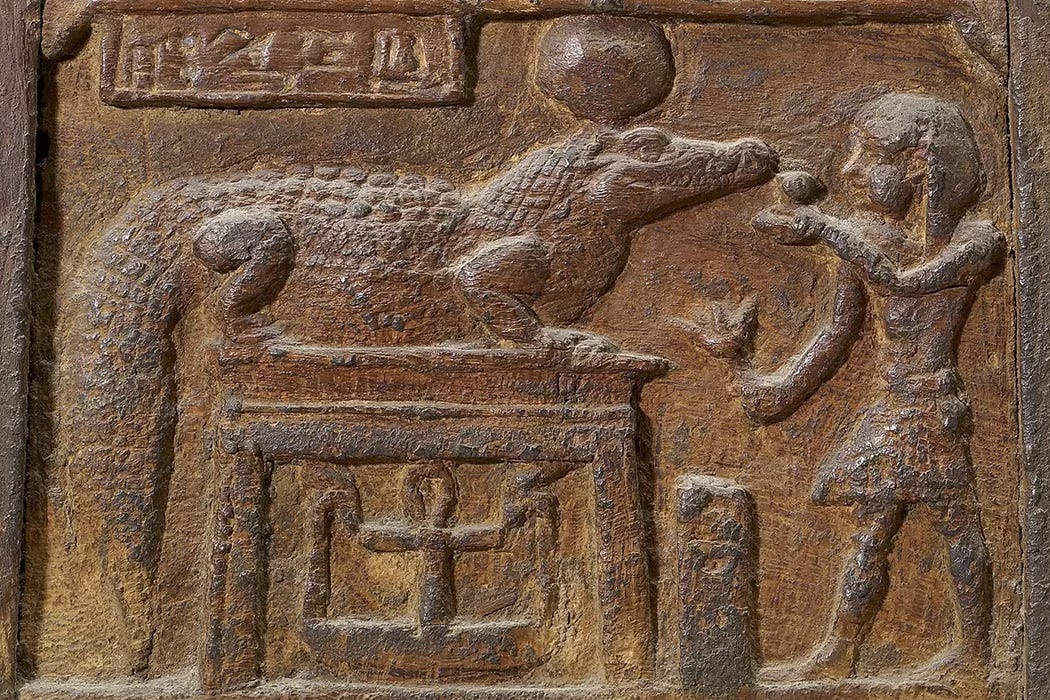
The panel of a chest depicting a King making an offering to the crocodile god Sobe. 1st century BC (Greco-Roman Egypt). The original is in the Walters Art Museum in Baltimore.
In the market at Aswan I made friends with a man and his grandson who were making kanafeh. Kanafeh (there are different spellings like ‘kataifi’ in Greek) is the fine dough used to make those shredded-wheat type sweetmeats you see all over the Eastern Mediterranean. The little boy was turning a handle that a spun a metal plate with a charcoal fire gently smouldering underneath it. It was a bit like those machines that make candy floss at fun fairs. The grandfather poured the liquid dough in the thinnest trickle onto the hot plate and then scooped it up seconds later at the perfect moment of dryness. I asked if I could take a photo and offered the little boy a few piastres which were waved aside by his grandfather. They stood side by side for the photo, smiling broadly and were so proud of their home made machine, their craft and their simple and wholesome product. I wish I still had the photo but I don’t. The humbling moment now exists only in my memory.
Kosheri (for 2-3)
This typical Egyptian street food. There are loads of versions and this is mine. I often make it when I’m on my own and eat it over two nights.
200g rice – weigh in a measuring jug. I usually make this with a mix of rices - basmati, wild and red. You can buy ready mixed packs.
100g lentils – brown, green or puy (one of those vacuum packs would be good here)
1 large onion
Olive oil
A few gratings of ground nutmeg, 1 teaspoon cinnamon and ½ teaspoon ground coriander, salt
A few toasted almonds or pine nuts
Chopped parsley
A spicy tomato sauce made by simmering a tin of chopped tomatoes with two crushed cloves of garlic, a splash of wine vinegar, dried chilli flakes and 1-2 tsps ground cumin.
Cook the lentils until soft but not mushy.
Warm a tablespoonful of olive oil in a pan and add the spices - heat them gently, you don’t want to scorch them. Add the rice and turn it until coated with oil, now add double the volume of water to rice, season and put on the lid. Simmer until the rice is cooked and all the water absorbed. Finely slice the onion and fry until dark golden brown – a few caramelised bits are nice.
Gently mix the cooked rice with the lentils and put onto a warm dish, tip the onions over the top and sprinkle with the nuts and parsley. Serve with the tomato sauce. I seem to remember they gave it to us in Egypt with butter-fried hard boiled eggs on the side.
I think this is deeply comforting food.
I can’t resist giving you the whole of a poem by the Armenian poet Zahrad Yaldizciyan (1924-2007) Try reading it out loud to yourself.
A Woman Cleaning Lentils
A lentil, a lentil, a lentil, a stone.
A lentil, a lentil, a lentil, a stone.
A green one, a black one, a green one, a black. A stone.
A lentil, a lentil, a stone, a lentil, a lentil, a word.
Suddenly a word. A lentil.
A lentil, a word, a word next to another word. A sentence.
A word, a word, a word, a nonsense speech.
Then an old song.
Then an old dream.
A life, another, a hard life. A lentil. A life.
An easy life. A hard life, Why easy? Why hard?
Lives next to each other. A life. A word. A lentil.
A green one, a black one, a green one, a black one, pain.
A green song, a green lentil, a black one, a stone.
A lentil, a stone, a stone, a lentil.
Isn’t that just brilliant?
x Liz.
We went to Egypt for a conference (Melinda as speaker, me as map-reader and bag carrier). We found Cairo quite unsettling and after the conference took a train down to Luxor. The train was filthy and had no air conditioning, but at least it was authentically Egyptian. The museum at Luxor was one of the best we’d seen. We crossed over to The Valley of the Kings, where I secretly threw a plasticine pebble containing some of my brother’s ashes in between two pharaohs’ tombs. On our last day, back in Cairo, we got food poisoning. The Curse of the Brother’s Ashes.
Well that went off too soon. I wanted to say how good the recipe sounds (but then all your recipes do!).