
"The Titillating Dust"
Mary Delany and the botanising woman.

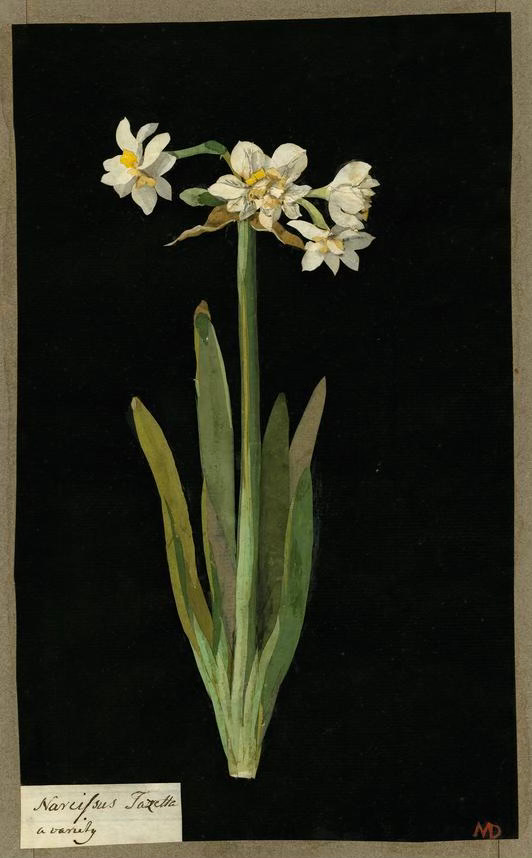
Narcissus Tazetta (Hexandria Monogynia), from album (Vol.VI, 96) 1776
I’ve been thinking since I wrote last week’s piece, about the way Mary Delany would have been viewed when she re-entered society in the mid 1720s after the death of her elderly husband. She was still a young woman. Was there prurient speculation about her failure to conceive during her seven year marriage? Were people wondering if she was still a virgin? It was completely normal at the time for widows to re-marry pretty rapidly, especially if they were left as Mary was, with limited financial means. There was also an underlying belief that once a woman had been sexually initiated she might be available for ‘adventures’. A second marriage was one way a widow could protect her reputation.
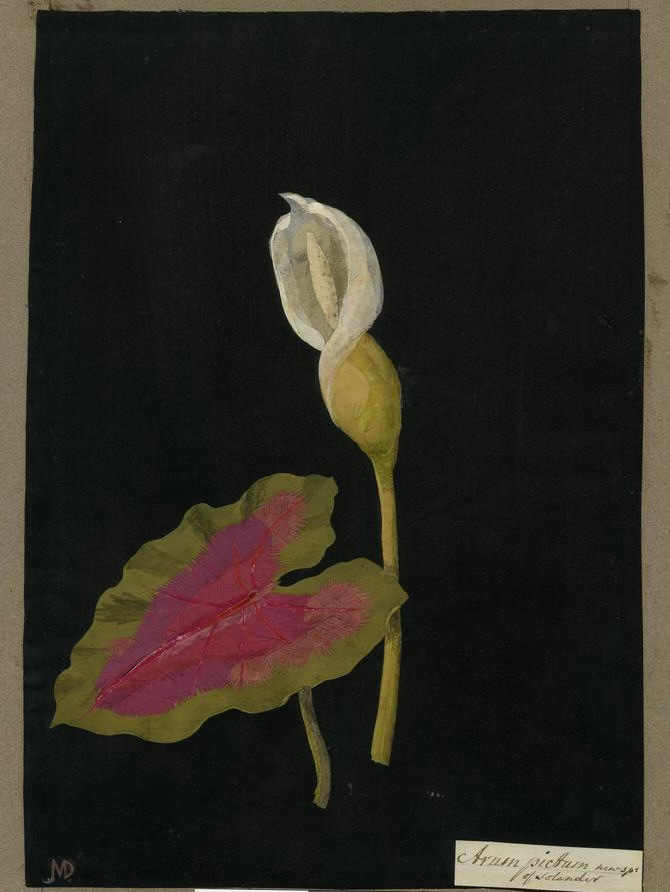
Arun Pictum (Gynandria Polyandria), from an album (Vol.I, 86); New sp: of Solander. 1778-80
May’s refusal to remarry in these circumstances is unusual. Her continued single state would explain the great care that she took to protect herself against any suggestion of social and sexual impropriety. Even as late as 1766 she refused to meet her brother’s neighbour Jean Jacques Rousseau (who also knew her friend the Duchess of Portland) because of his ‘dangerous ideas’. Mind you in the mid eighteenth century, if she had refused to meet any man with a libidinous reputation, her social life would have been as that of a nun - and she had no such scruples about Joseph Banks.
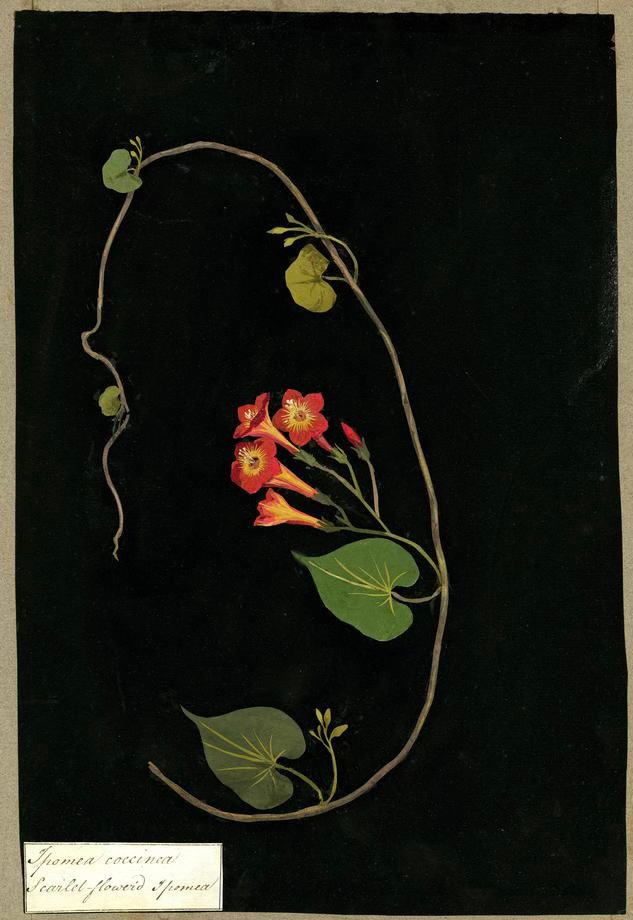
Ipomea Coccinea, (Vol.V, 68); Scarlet flowered Ipomea. 1779
In the context of female propriety however, Mary did something really interesting and radical. In her second widowhood she became a Linnaean.
Just a little aside here. Botanising was an acceptable hobby for women in the eighteenth century (sweet, feminine, pastoral, all about pretty things) but then Linnaeus’s sexual system of classifying plants burst onto the scene and he expressed the sexual characteristics of flowers in human language. Male stamens are described as ‘husbands’ and female pistils as ‘wives’. That flashed all sorts of warning lights for masculine scientific society. What would women do when they discovered that female plant parts could be fertilised by many different males? Giving such knowledge to women offends modesty and encourages wantoness. Plants are promiscuous and get up to all sorts of naughtiness. How shocking.
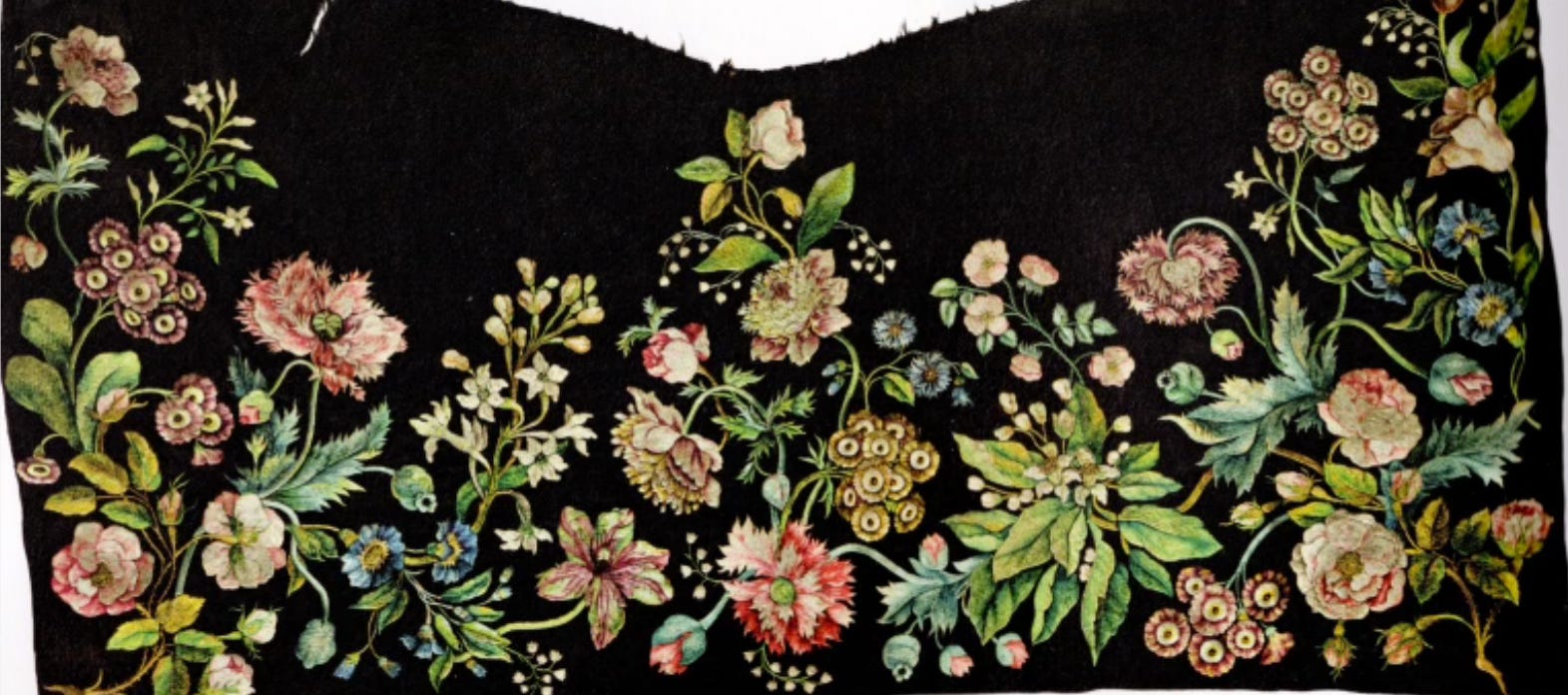
Part of an embroidered petticoat designed by Mary Delaney around 1739 and worn by her at Court. Perhaps the inspiration for the black background of the paper mosaics.
Mary Delany’s flower mosaics started as a feminine amusement and built on the paper cutting skill she already had. However they rapidly turned into a scientific endeavour when she named and classified her illustrations according to Linnaean taxonomy. Linnaeus wrote his important works in Latin and it seems likely that his Species Plantarum published in 1753 was available to her in the Duchess of Portland’s library, as was James Lee’s book ‘An Introduction to Botany’ (1760). Lee’s book was the first to introduce the idea of sexual classification to English readers.
However, the most likely source of Mary’s Linnaean knowledge was through Linnaeus’s pupil Daniel Solander and through Solander’s friend the great Joseph Banks. Banks was appointed as an informal director of the Royal Botanical Gardens at Kew by George III in 1773. Both of these men were well known to Margaret, Duchess of Portland, who by the 1770s was running what amounted to ‘a one woman research institute’ * at her country home at Bulstrode. It was there that Mary spent several months every year and where she became a pioneer of Linnaean taxonomy. It was another twenty years before it was adopted into common usage.
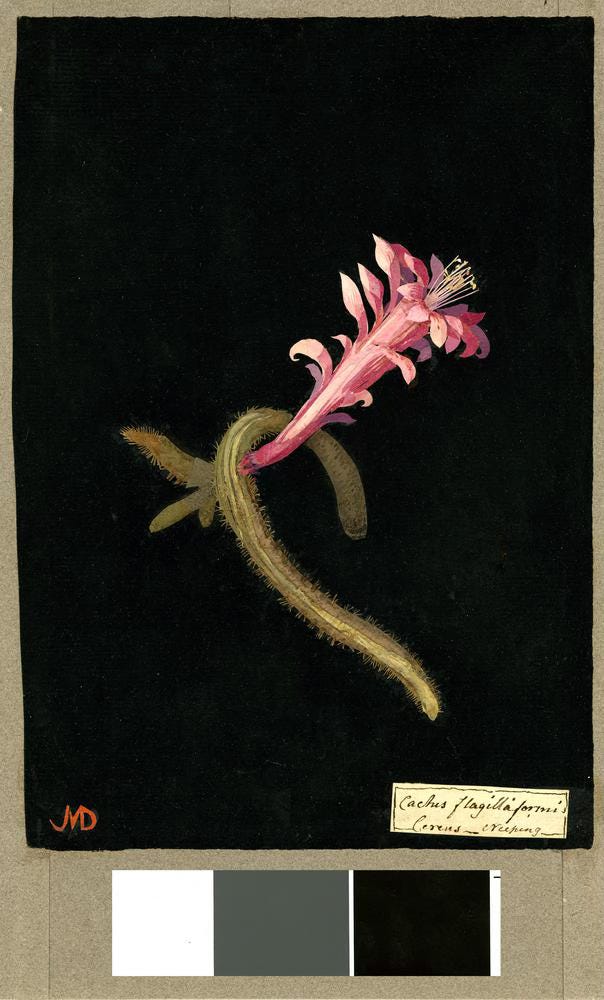
Cactus Flagillaformis (Icosandria Monogynia), (Vol.II, 33); Creeping Cereus. 1775
Between 1772 and 1782 Mary Delany created over 900 paper mosaics. That’s almost two every week. They were each made up of hundreds of tiny pieces of hand coloured paper, stuck down with a simple flour and water paste onto a black background that she had painted herself. She used a small pair of scissors and a couple of bodkins to set them out - surely she must have used tweezers too? She corresponded with many people who forwarded plant specimens to her, including Joseph Banks who sent her specimens from Kew. She found the whole process completely satisfying; it was the perfect combination of intellectual stimulation, social contact and quiet meditative craft.
Mary set herself a target of 1000 specimens in her ‘Flora Delanica’ but sadly the cataracts she had been suffering from eventually got the better of her. She wrote:
“The time has come! I can no more
The vegetable world explore
No more with rapture cull each flower
That paints the mead or twines the bower…”
The debate about woman and botanical knowledge raged on after Mary’s death in 1788. In 1798 the Cornish poet and clergyman Richard Polwhele wrote a blistering attack on women botanists whom he believed were sexually arousing themselves by looking at plants..
With bliss botanic as their bosoms heave,
Still pluck forbidden fruit, with mother Eve,
For puberty in signing florets pant,
Or point the prostitution of a plant;
Dissect its organ of unhallow’d lust,
And fondly gaze the titillating dust.
‘The Unsex’d Female’ (1798)
What would Polwhele have made of Georgia O’Keefe? On the other hand he wasn't the last person to see sexual awareness in women’s botanical illustration. Daisy Lafarge has a go in this article for the Tate, although I think her attempt to claim Mary for Queer Culture is a bit wishful.
https://www.tate.org.uk/tate-etc/issue-62-summer-2024/mary-delany-a-thousand-queer-gardens-
After Mary’s death, The ‘Flora Delanica’ was organised into ten albums and in 1897 was bequeathed to the British Museum by her great-niece, Augusta Hall. Pages from it are on display in the Enlightenment Gallery.
Mary Delany is buried in St James Piccadilly. I must have walked past there a hundred times and I’ve never been in. I will one day.
Notes
* Clarissa Campbell Orr’s words. (ibid last week)
All images The British Museum @Creative Commons.
Sam George’s book ‘Botany, Sexuality and Women’s Writing 1760-1830’ Manchester University Press (2007) is a mine of useful information if you would like to know more.
I remember Mary Delaney as one of the highlights of the rather patchy women artists exhibition at the Tate a couple of years ago.
I do love botanical prints and love learning about artists who produced them. I think it's very funny the paranoia about females getting sexually aroused. What about the male botanist's experiences, if that is the case?